
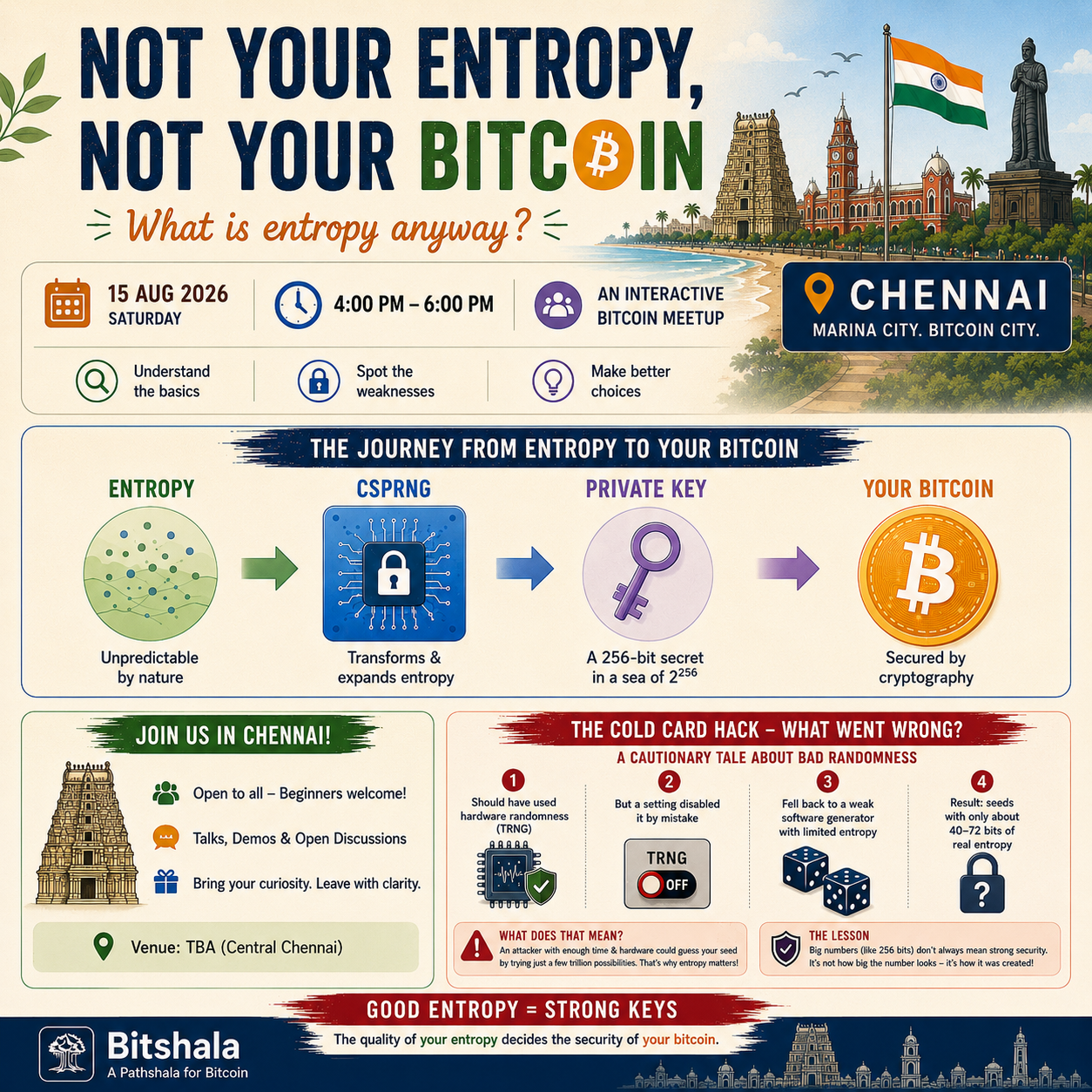
Not Your Entropy, Not Your Bitcoin | Chennai
Every Bitcoin wallet eventually comes down to one thing: a secret number nobody else should be able to guess.
We usually trust our hardware wallet, phone, or computer to generate that secret for us. It gives us 12 or 24 random-looking words, we write them down, and move on.
But here’s the uncomfortable part:
24 words don’t automatically mean 256 bits of security.
If the process that created those words was predictable, an attacker doesn’t have to search the enormous Bitcoin keyspace. They only have to reproduce the weak process that generated your seed.
And a recent vulnerability in Coldcard hardware wallets gives us a very real example of what that can look like.
This meetup is about understanding what actually sits underneath the words randomness, entropy, and secure key generation — without treating the wallet as a black box.
Randomness vs entropy
They’re often used interchangeably. They shouldn’t be. We’ll build an intuitive understanding of what a “bit of entropy” actually means.
From entropy → private key
Why Bitcoin has roughly 2^{256} possible private keys, and what it really means to randomly choose one.
Where computers get randomness
Computers are deterministic machines. So where does a CSPRNG get the unpredictability needed to create Bitcoin keys?
12 words vs 24 words
Why a 12-word BIP39 seed starts with 128 bits of entropy while a 24-word seed starts with 256 — and why 12 words can still be cryptographically strong.
When the RNG goes wrong
We’ll unpack the Coldcard failure at a conceptual level: how a wallet can output a 256-bit-looking value while the process behind it contains far less entropy.
Hardware randomness vs physical randomness
We’ll compare device-generated entropy with things you can actually do yourself: Dice, Coins, Camera images.
Drawing BIP39 words from a bag.
This meetup will probably click if:
You do not need a cryptography background. We will use some math, but only where it helps us reason about the problem.
This is also not a “which hardware wallet should I buy?” session.
It’s about understanding one of the assumptions every wallet ultimately depends on.
Bitshala is a Bitcoin-focused education initiative where we help developers, designers, and curious builders learn by doing. We run cohorts, clubs, workshops, a hackerspace, and community programs that make it easier for people to explore, contribute to, and build on Bitcoin. Our focus is on hands-on learning, proof-of-work, and growing alongside a community of people who care about open technology, design, and the future of money.
If you'd like to explore more, check us out on: